
A week ago I visited the Bay Area with one clear vision: to build a knowledge bridge between Armenian and American research and educational institutions. The greatest outcome of that trip was not just the future projects that will eventually come to life, but something less tangible - discovering so many new Armenians, and seeing firsthand their commitment to their country. That pride, that pull, that quiet loyalty. It never gets old.
But before I get into how smart and wonderfully stubborn we are as a people, let me share two moments from that trip that stayed with me.
I had a meeting at Stanford with the AI research lead at the d.School. On my way there, trying to navigate the campus, I crossed paths with a man I didn't know. I briefly introduced myself, mentioned Armenia and he interrupted me with a smile. He had a good friend in Armenia, he said. They had khorovats (barbeque) together once. This man, as it turned out, was the academic director of the school. The friend he'd shared khorovats with was one of the former rectors of NPUA. I walked into my meeting with my head a little higher.
That meeting was with Larry, the founder of AI Design Research at Stanford. We talked about the future of artificial intelligence and where it's all heading. The key point he made has stayed with me: the one thing AI is not going to take over at least for the next 200 years is Emotional Intelligence, the latter, he said, should be the frontier. As he spoke, I found myself thinking of a conversation I'd had back in Yerevan about building emotional intelligence around objects and humans. I felt something I can only describe as quiet pride, not just that I understood what Larry was saying, but that we were already working on it.
Then came San Jose, and a meeting with Mary Papazyan, a beautiful soul, a proud Armenian, an extraordinary leader, someone who opened every door for possible cooperation and left me with that particular feeling Armenians give each other when they meet abroad and recognise something of themselves in the other person.
Back in Yerevan, I found myself sitting with three young Armenians - Vazgen, Hambardzum, and Ashot moderating one of the most exciting events happening in the country.
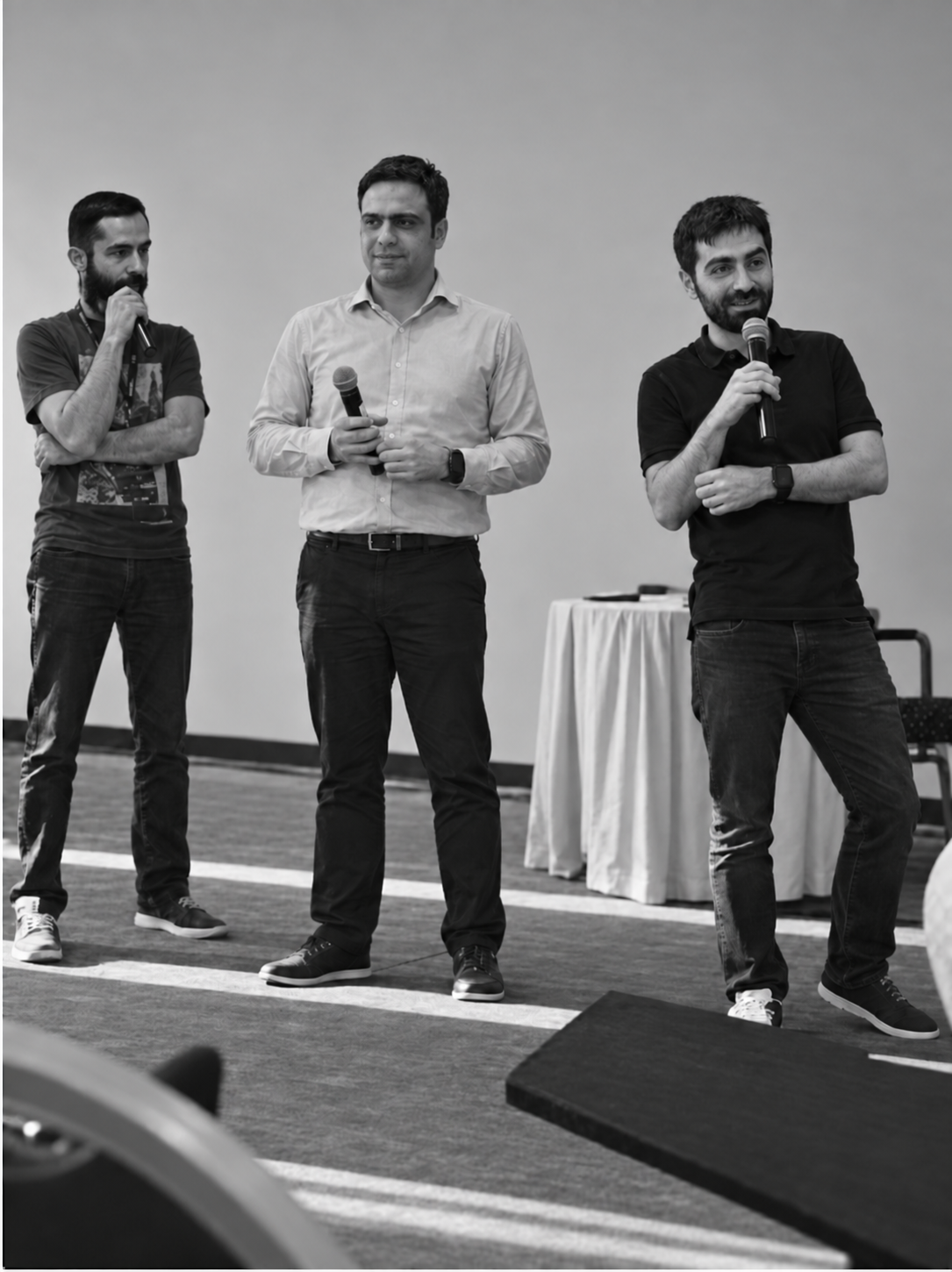
And looking at the speakers in the room: Ruben Vardanyan, Aram Pakhchanyan, Naira Hovakimyan, Aram Salatyan, Armen Orujyan and others. Uncommonly different people. Radically different views. And yet all of them in the same room, in Armenia, together - unleashing what I've started calling the Armenian Intelligence.
That's the one thing that connects all of us. Not geography. Most of us aren't even in the same country. Not a government or an institution. Something older. A recorded history of 3,500 years, currently distributed across the world, and somehow still coherent.
So here is the equation I keep coming back to:
X = AI (Artificial Intelligence) - going to reshape most of the world's workforce in the near future.
Y = AI (Armenian Intelligence) - creative, mostly irreplaceable by X, capable of teaching X, and able to lead it.
T = 20 years
The employed world population: 3 billion. Armenians worldwide: 11 million, with an assumed employment rate of 60%. Given all of the above and the fact that physical borders no longer matter, what can be the role of Y in T?
My answer: we are very close to the Armenian Dream. All we need is to start using the AI we already have.
Oh, and one more thing, through the vector of friendship. Always.
A special note: the term "Armenian Intelligence" was coined by Nathalie, age 8, who was the real motivation behind my first story.
Share this story
WhatsApp · Facebook · LinkedIn · Telegram · Email · Copy link
https://armenianintelligence.am/en/archive/the-ai-dream?utm_source=reader_copyHave a story that belongs here?
Share Your Story →