
1920
The Treaty of Sèvres was signed between the Allied and Associated Powers and the Ottoman Empire on August 10, 1920. The treaty recognised Armenia as a free and independent state. The drawing of definite borders was left to President Woodrow Wilson - and the new borders gave Armenia access to the Black Sea and awarded large portions of eastern Ottoman provinces to the republic.
1923
The Treaty of Lausanne effectively replaced Sèvres. As Mustafa Kemal Atatürk later stated, the question of an Armenian state in Anatolia had been eliminated.
On the morning of 25 July 1923, the Gazette de Lausanne described the ceremony in detail. At ten past three, in the Aula of the Palais de Rumine, Ismet Pasha was invited to sign first. He used a gold pen. The signing took thirty-two minutes, and afterwards the delegations moved on to a reception at the Hôtel Beau-Rivage.
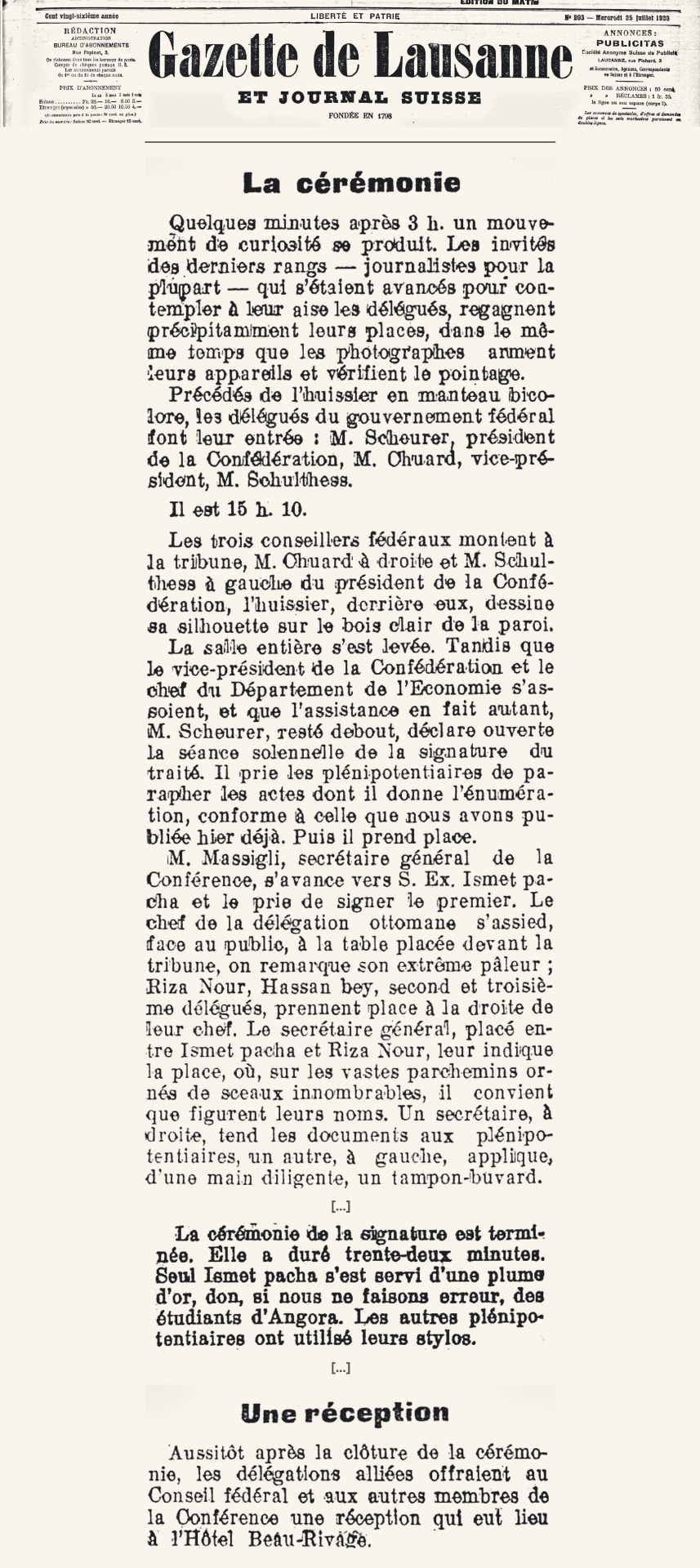
Armenia is not mentioned once. Not in the account of the ceremony, not in the summary of the treaty's 143 articles. Eight years after 1915, after a genocide that took the lives of 1.5 million Armenians, the treaty that closed the door on an Armenian state passed without a single word about us. The only Armenians in that day's paper are 7,000 refugees, counted in the camps of Constantinople.
That silence is part of the story too.
April 12, 2018. Three young Armenians, all born in the mid-80s, all carrying that particular brand of Armenian Intelligence shaped by the difficult 90s, are having dinner in one of the most historic restaurants in Lausanne. A few steps from the château where the Treaty of Lausanne was negotiated.
I never loved history class at school. I could never memorise all those names and dates - maybe my brain resisted unstructured information. But I always remembered my teacher's face, and the emotion in his voice, when he told us how the Treaty of Lausanne buried the Treaty of Sèvres. I remembered it clearly, standing in that hallway in Lausanne, listening to a man from South America tell me enthusiastically: "The Republic of Turkey was established here! You know Turkey, right?"
Imagine the effort it takes to set aside everything that is genetically stored somewhere deep inside you, to breathe, to find the polite and measured version of the story, to say calmly: well, now you know who Armenia is.
This is what every Armenian does, every day, at every international event. You introduce yourself. You name your country. And then you tell the story - again, so that people understand where you come from and why it matters.
Mariam, Gor, and I had all arrived in Lausanne for different reasons and found each other by accident, the kind of accident that Zuckerberg's creation makes possible. Mariam represented the private sector, heading an R&D initiative at one of the world's leading corporations. Gor had brought his startup from Gyumri to a Seedstars competition. I was there to build new partnerships for Armenia. Three people, three missions, one table.
We were all doing the same thing in our own way: trying to position our country as well as it deserves. All of us had studied or worked abroad. All of us had come back to Armenia - not because it was easy, but because the potential is real, and someone has to help it reach the world.
The conversation that evening was about our lives, our families, our great-grandparents, all descendants of the Armenian Genocide. The energy in that room was extraordinary. We didn't notice the restaurant closing around us. The waiters waited, patiently, for around 40 minutes. I think they understood something was happening at that table.
With as small a population as we have, there is a core group of Armenians - young, competent, driven, who are among the most sought-after people in the world right now. It was three of us in Lausanne. Multiply that by thousands, and you have the number that can make Armenian Intelligence happen at scale.
We all carry that pain somewhere, locked safely deep inside, transformed over generations into a force that pushes us forward. To win. To preserve that last precious particle of Armenian identity. Not to walk over it.
If the First Republic of Armenia had held, we would now be celebrating over 100 years of independence. It didn't hold. The question of why - why Armenians couldn't push hard enough, why the world looked away, whether it was fear or something else entirely, is one historians still argue about. I won't pretend to have the answer. But I am certain of one thing: whatever the reason was, it cannot be permanent. The momentum of truth has a long memory.
We need to make Armenian Intelligence happen. Or we risk losing the last generation that still remembers why it matters.
The dinner that evening took place in the building where Lord Byron wrote The Prisoner of Chillon in 1816. Byron may have been the first Westerner in the modern era to take a serious interest in Armenian culture - calling the Armenian alphabet "the thirty-eight cursed scratches of Mesrob, the maker of alphabets." He tried to learn it anyway. Some things about Armenians have always made people try harder than they expected to.
Share this story
WhatsApp · Facebook · LinkedIn · Telegram · Email · Copy link
https://armenianintelligence.am/en/archive/making-ai-happen?utm_source=reader_copyHave a story that belongs here?
Share Your Story →